2022/23 Acquisitions

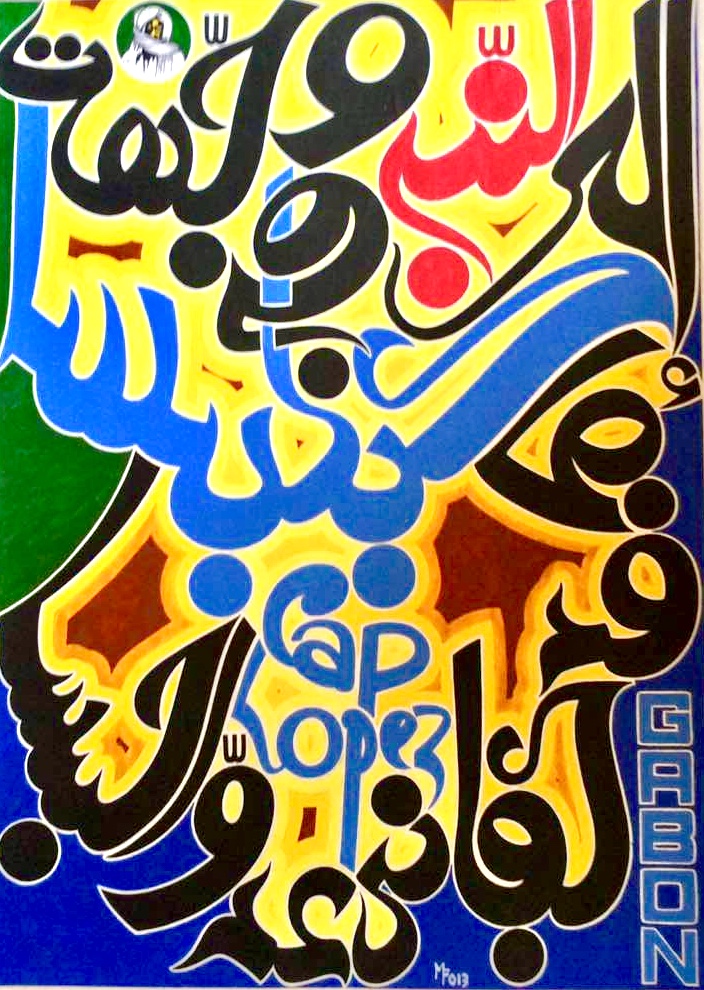
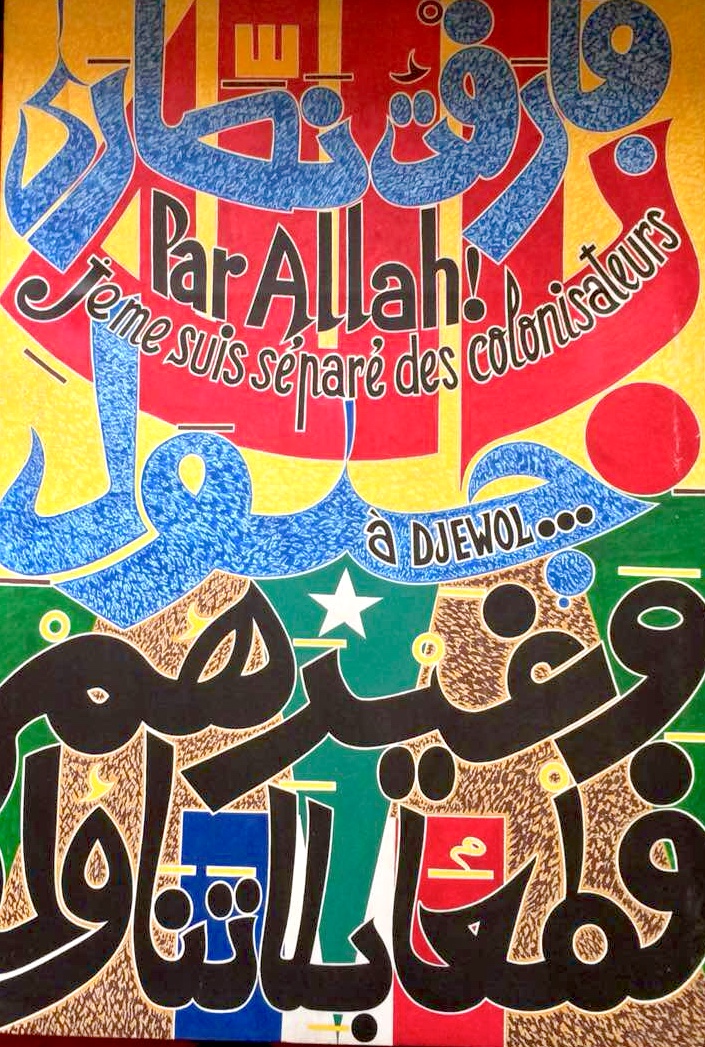
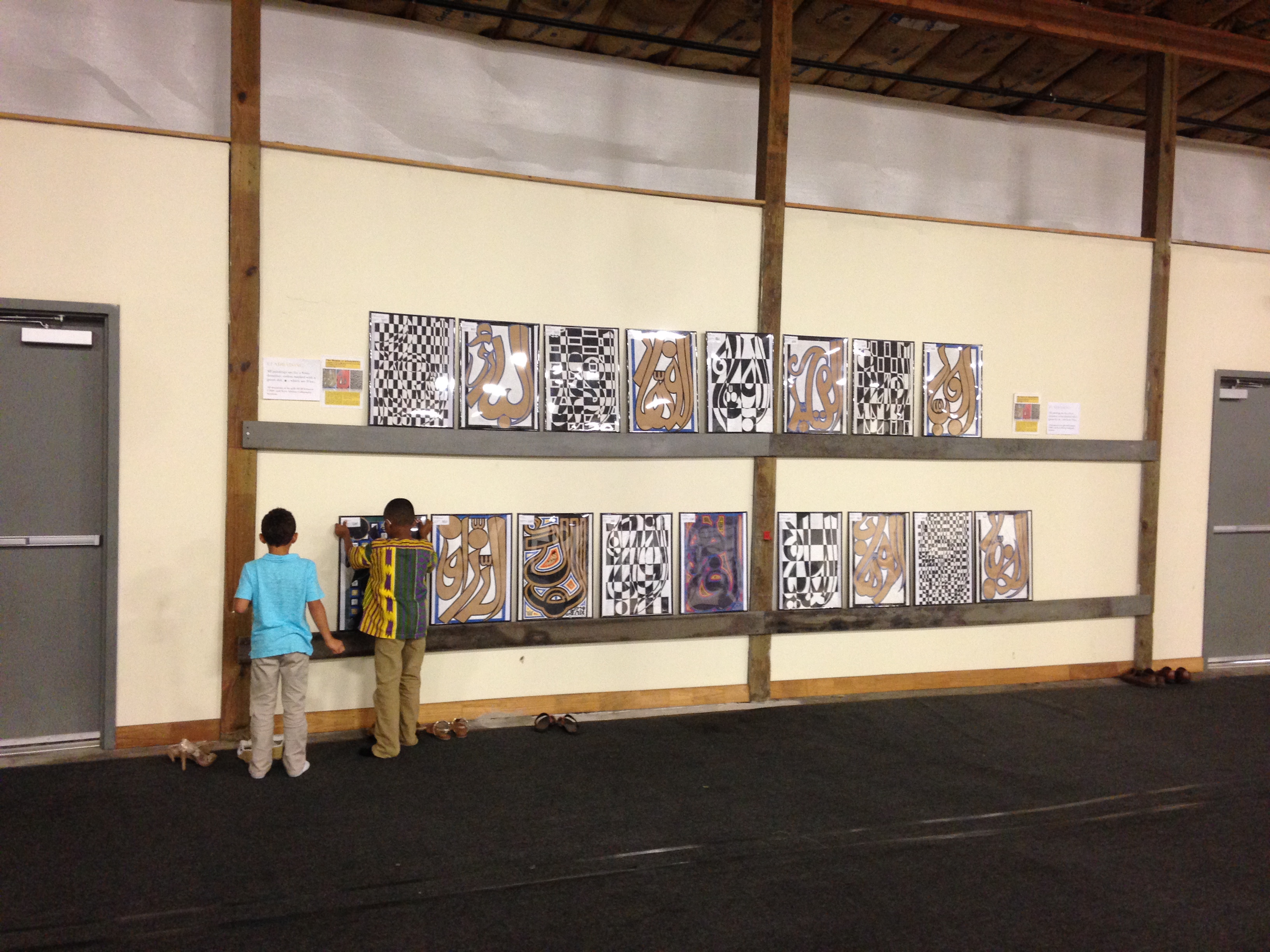
Asalaam alaykum! The West African Calligraphy Institute is happy to announce some recent acquisitions of Yelimane Fall’s work. The Ackland Museum at UNC Chapel Hill is the new home to an amazing collection that focuses on Ahmadou Bamba’s exile during the French occupation of Senegal. This collection serves an interdisciplinary purpose, shining light on the story of Ahmadou Bamba, French colonialism, Senegalese culture, and West African Islam, as well as being an inspirational exemplar of Contemporary African Islamic Art. We know Yelimane would see it as a blessing and protection for students of UNC and people of North Carolina.

Ackland Museum at UNC
Chapel Hill, NC
Boston Museum of Fine Arts
Boston, MA

An extremely important acquisition of some of Yelimane’s major works was also made by the Boston Museum of Fine Arts. The pieces in this collection are among the finest examples of Yelimane’s signature calligraphie negro africane, and centered on the khassaides (poetry) of Ahmadou Bamba and West African Islam. These powerful pieces demonstrate some of Bamba’s central teachings, while highlighting the richness and diversity of art in the Islamic world.

And finally, two very unique pieces from the Protection Series were acquired by MIT’s Aga Khan Documentation Center. We are humbled and excited that Yelimane’s artwork continues to be exposed to new audiences, furthering the blessing and teachings of Ahmadou Bamba.

We sincerely thank everyone we worked with at these institutions to get more of Yelimane’s calligraphy out into the world. There is truly a beautiful community of people working in the worlds of Islamic and African arts, and it is our hope that some of Yelimane and Fallou’s pieces can be part of bringing people together and doing greater work. These acquisitions have helped the Institute’s mission in Senegal to continue building the school and research center in Sangalkam, and creating a satellite space for guests and workshops in Touba.
Bamba Mos Xam (Bamba, The Taste of Knowledge)

It is crucial to acknowledge and celebrate the role of culture in spreading ideas, preserving knowledge, and growing community.  This is precisely the work of the West African Calligraphy Institute and the artwork of Yelimane Fall. Yelimane draws on the deep cultural heritage of the Muriddiya to represent the khassaides of Serigne Touba, and Bamba’s vision of a society guided by a mystical and inward looking interpretation of Islam.  This wonderful video documentary, put together by Brian Valente-Quinn and Gino Canella out of the University of Colorado (Boulder), looks at how Mouridism has manifested in another cultural format – theatre. Take a moment to enjoy this important documentation of the 1970’s Senegalese theatre troop Bamba Mos Xam and their contemporary counterparts La Compagnie Sant Yalla, along with extensive commentary about Mourdism by intellectuals and artists, including our own Yelimane Fall.

The Paintings of Yelimane Fall: Community, Literacy, and Activism in Islam

AD for ASA.jpg

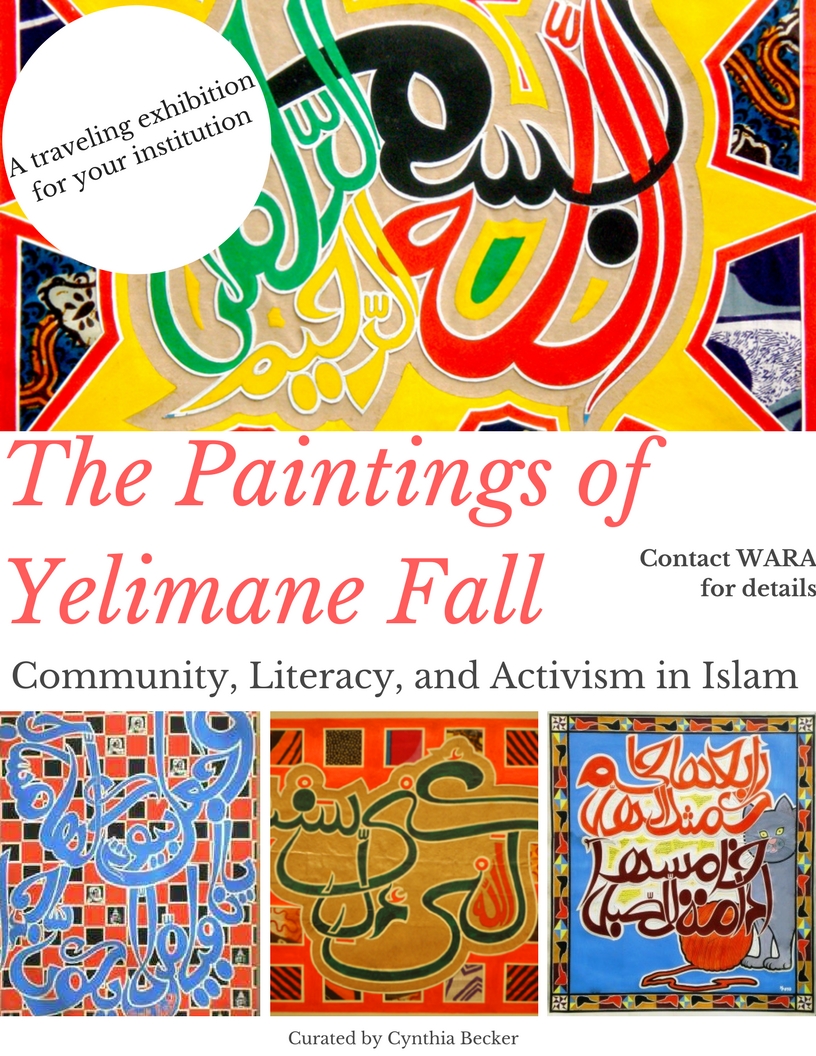
The exhibition The Paintings of Yelimane Fall: Community, Literacy, and Activism in Islam was put together at the West African Research Association. After premiering at Boston University, in winter of 2017 it was exhibited at Lafayette College in Easton, PA. It is now available to be shown at participating institutions, with costs going to support Yelimane Fall/West African Calligraphy Institute and the West African Research Association.

From the exhibition:

Senegalese artist and community activist Yelimane Fall has a unique calligraphic style that reflects a vibrant West African aesthetic. His work draws on the teachings of Shaykh Ahmadou Bamba, the founder of the Mouride Sufi order in Senegal, and focuses on the values of tolerance, self-reliance, and hard work. He also uses Ajami, the Arabic alphabet adapted for writing West African languages, which appeals to wide local audiences throughout West Africa.

The show opens up discussions of Africa, religion, and community, providing a much-needed positive portrayal of the region through modern, familiar, and captivating imagery.

Contact WARA today to learn how you can bring Mr. Fall’s vibrant images to life in your institution.

Exhibition: Magal juli geej gi & magal ñaari raaka

4E3D263A-168D-48B8-9627-2645D1617309.jpeg

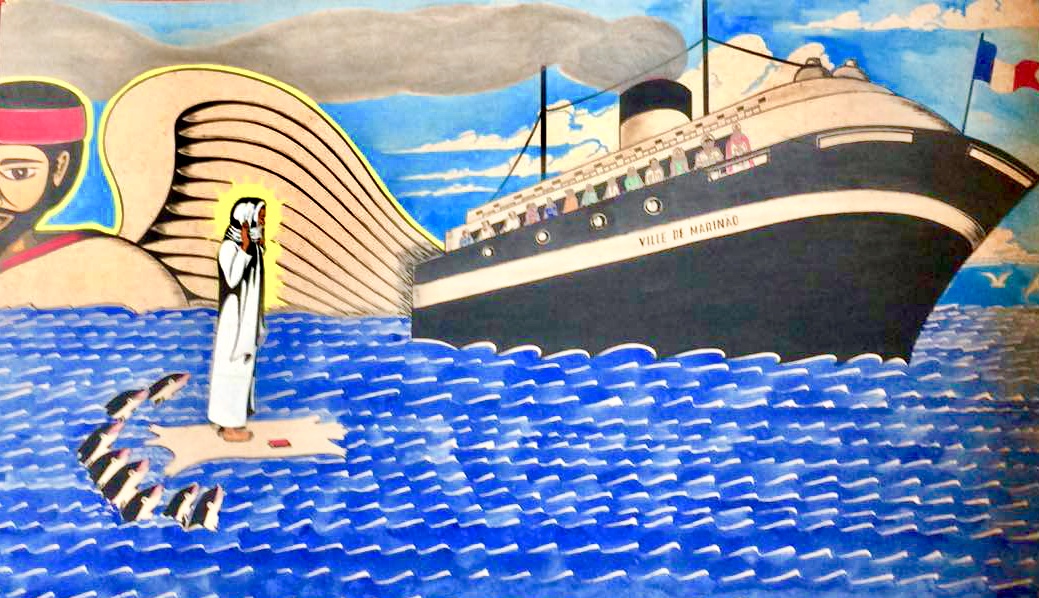
The story of Cheikh Ahmadou Bamba is one of spiritual transcendence and resistance to French colonization. Although the French exiled him to Gabon and later Mauritania, attempted to assassinate him many times, and tried to force him to denigrate his religion, Bamba and the Sufi Brotherhood he founded persevered.

565FF73D-D346-4538-9756-8B4F54FCE873

© Yelimane Fall

He proved that his sacrifice and loyalty to Allah alone would prevail him from colonial forces, and make his message of peace, work, education, and devotion known throughout Senegal, Africa, and the world. And so it was . . .

844C78BD-B156-4205-8C1D-12C3F7A262E4.jpeg

© Yelimane Fall

In 2017 & 2018 the West African Calligraphy Institute was (and will always be) proud to exhibit and share calligraphy at 2 of the most important Mouride pilgrimages commemorating Bamba’s alligence to The One and rejection of French violence and hostility: Magal Juli Geej Gi (when Bamba was not allowed to pray during his journey into exile and so he prayed on the ocean) and Magal Ñaari Raaka (when Bamba refused to acknowledge French colonial authorities and prayed 2 raakas to Allah rather than speak to a colonial tribunal).

Maybe this September we’ll see you there, inshallah!

Institut du Monde Arabe exhibition – Islamic Treasures of Africa: From Timbuktu to Zanzibar

From April 14, 2017 to July 30, 2017, Yelimane was part of a widely publicized and highly reviewed exhibition at the Institute of the Arab World in Paris, France.  The exhibition, entitled Treasures of Islam in Africa: From Timbuktu to Zanzibar, was attended by the presidents of France, Mali, Burkina Faso, Mauritania, and Morocco.  A very large piece by Mr. Fall was exhibited alongside a reproduction of the only known photo of Cheikh Ahmadou Bamba.

The French international newspaper Le Monde also did a video gallery-walk of the exhibition, and you may see Yelimane Fall’s work (and other examples of African calligraphy and Islamic art) by watching the video embedded in their Compte Rendu: Revivez notre visite de l’exposition « Trésors de l’islam en Afrique » à l’IMA from 4/13/2017 (skip to 23:45).

The president of Morocco thought so highly of the exhibition he is having it brought to the Moroccan capital of Rabat in 2019.

The Odyssey of Ajami and the Muridiyya

9780190279868

Editorial Reviews

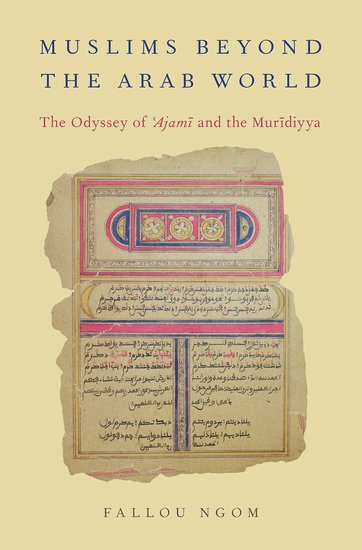
“[T]he book is essential reading for advanced scholars of the Muriýdiyya or Islam in Africa and it will be key to the scholar who constructs the regional odyssey of Ajamiý that is, the sociohistorical emergence of West African vernacular language literacy in Muslim contexts.”–Religious Studies Review

“For those who wish to make sense of recent events in West Africa, Ngom’s book is an excellent place to begin. He corrects many false images of Africa as a continent without writing and demonstrates the dangers of relying exclusively upon oral culture and colonialist-written sources alone. Ngom’s book has set a new standard for African studies.”–Reading Religion

“Fallou Ngom’s Muslims beyond the Arab World is a brilliant demonstration that Islam in Sub-Saharan Africa is not peripheral to a Muslim world centered on Arab societies: it is its own center and has produced throughout the centuries an important literature in Arabic, but also often in ‘Ajami, that is, texts written in the local languages adapting and using the Arabic script. Fallou Ngom’s work is centered on the ‘Ajamization of Islamic sciences and literature by Muslim scholars who authored important texts in Wolof, in poetry and in prose, following the recommendation of Shaykh Ahmadu Bamba, the founder of the Muridiyya Sufi order. Ngom’s book makes manifest that Islam is one and plural, that it speaks Arabic, the language of the Qur’an, but other Islamic languages as well, Wolof being one great example eloquently presented here as a language of written erudition.” -Souleymane Bachir Diagne, author of African Art as Philosophy: Senghor, Bergson and the Idea of Negritude

“This ‘Ajami odyssey makes a signal contribution to the study of Islamic thought in Africa and beyond. Ngom skillfully illustrates how the Muridiyya Sufi order has used African languages materials to make meaning and history, thereby becoming one of the most dynamic Islamic movements in the world today. By focusing on how Murids have articulated and embodied a unique vision of the past deeply rooted in humanistic values of peace, service, and ethics, Ngom also casts precious light on the development of vernacular languages, cultures, and historicities throughout the Muslim world.”-Rudolph T. Ware, Associate Professor of History, University of Michigan

About the Author

Fallou Ngom is Professor of Anthropology and Director of the African Studies Center at Boston University. His research interests include the interactions between African languages and non-African languages, the adaptations of Islam in sub-Saharan Africa, and ‘Ajami literatures-records of African languages written in Arabic script. He has held Fulbright, ACLS/SSRC/NEH, and Guggenheim fellowships.

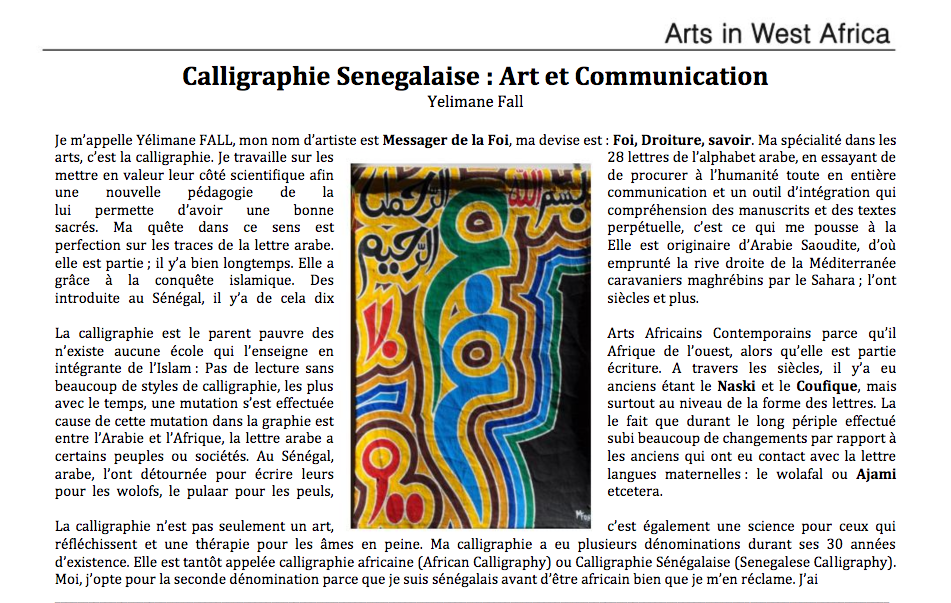
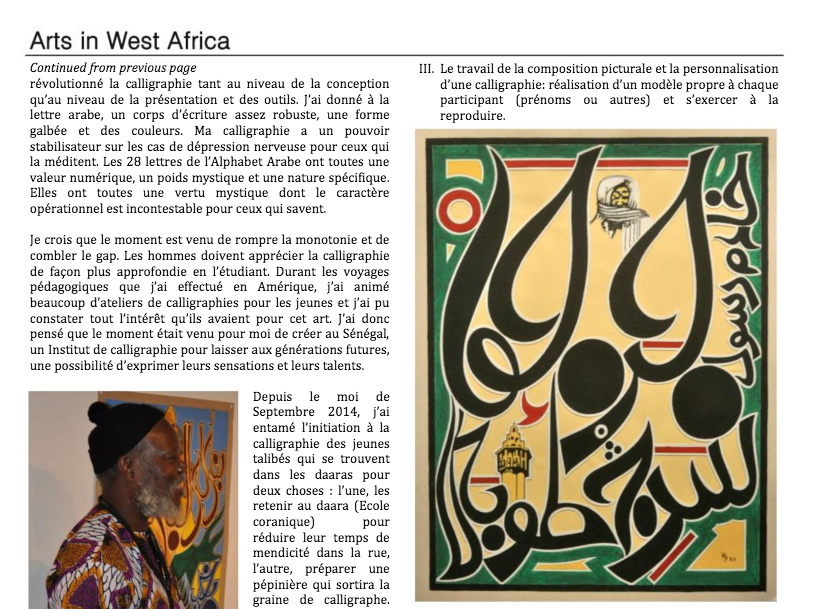
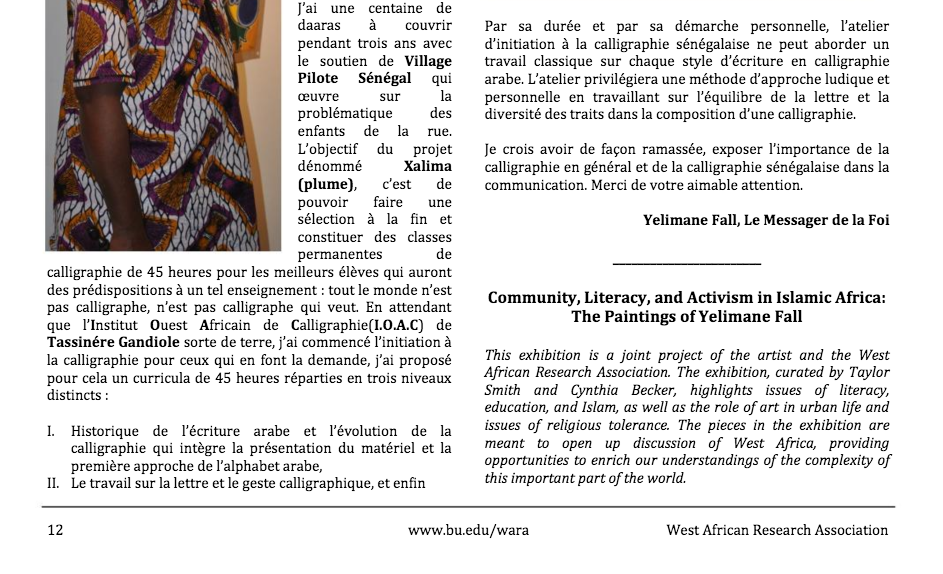
2015-2016 West Africa Research Association Newsletter

Yelimane wrote an article for the West African Research Association 2015-2016 newsletter, and in conjunction with an exhibition being put on by the center entitled Community, Literacy, and Activism in Islamic Africa: The Paintings of Yelimane Fall.

Screen Shot 2018-07-02 at 5.10.48 PM

Screen Shot 2018-07-02 at 5.18.08 PM.png

Screen Shot 2018-07-02 at 5.19.06 PM

Update: The exhibition “Community, Literacy, and Activism in Islamic Africa: The Paintings of Yelimane Fall” was most recently shown from August 2017 – December 2017 at Lafayette College in Easton, PA.

Dakar 2015/2016: Project XALIMA

DSC_8084.jpg

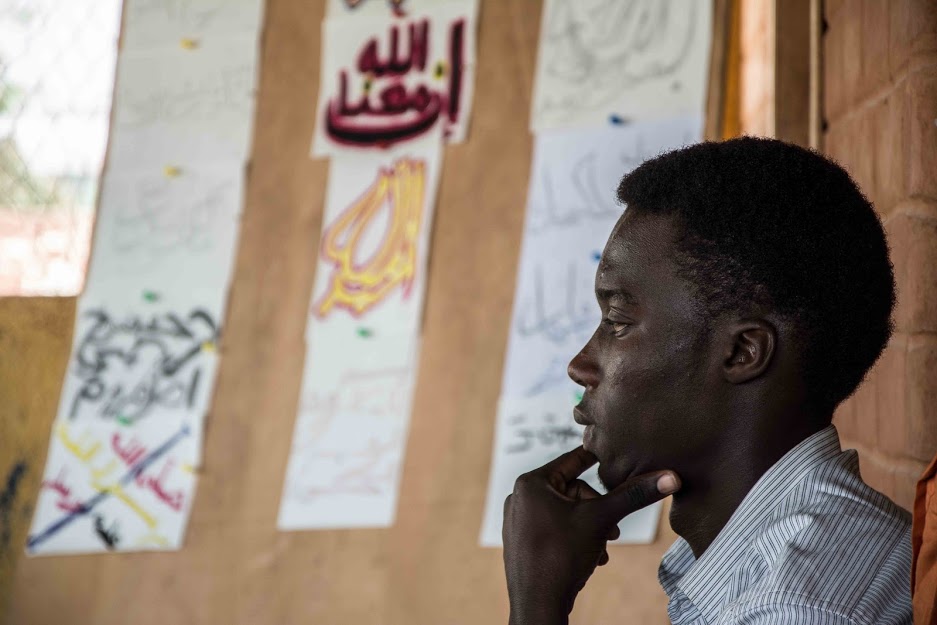
For the last year and a half the West African Calligraphy Institute has been working in conjunction with Village Pilote in Pikine, the French Development Agency, Islamic Relief France, and the Auteuil Apprentice Foundation on Project Xalima. Conceived by Yelimane Fall, this project uses the teaching of calligraphy to build inroads with hundreds of Daaras (Quranic schools) in the Dakar metro area.  In this way not only are the taalibes (students) exposed to the art of writing Quranic Arabic in the West African style, but they also receive medical attention and lessons on hygiene and health.

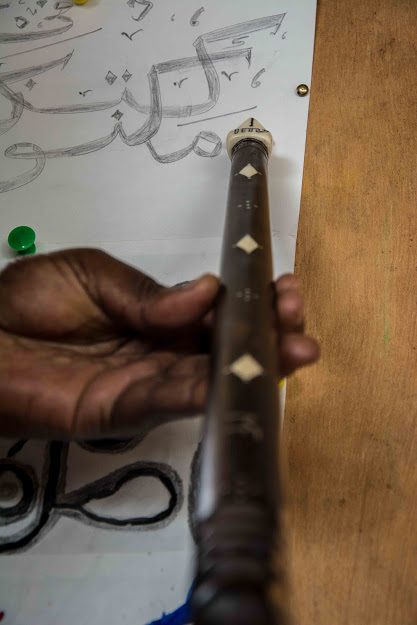
DSC_8072Xalima means pen in arabic.  Through the pen Mr. Fall sought to inspire and educate the young students (ages 5-17) while making crucial contacts and connections with the various serignes (teachers) of the Dakar area.  Working along with the teachers over a period lasting from Fall 2015 to Spring 2016, Mr. Fall selected 33 of the most writing proficient taalibes to participate in a special 45 hour apprenticeship in calligraphy.  The taalibes met for two hours a few days a week for 2 months to experiment with their own styles, learn more in depth about the mystical significance of the letters, and hone their writing craft.

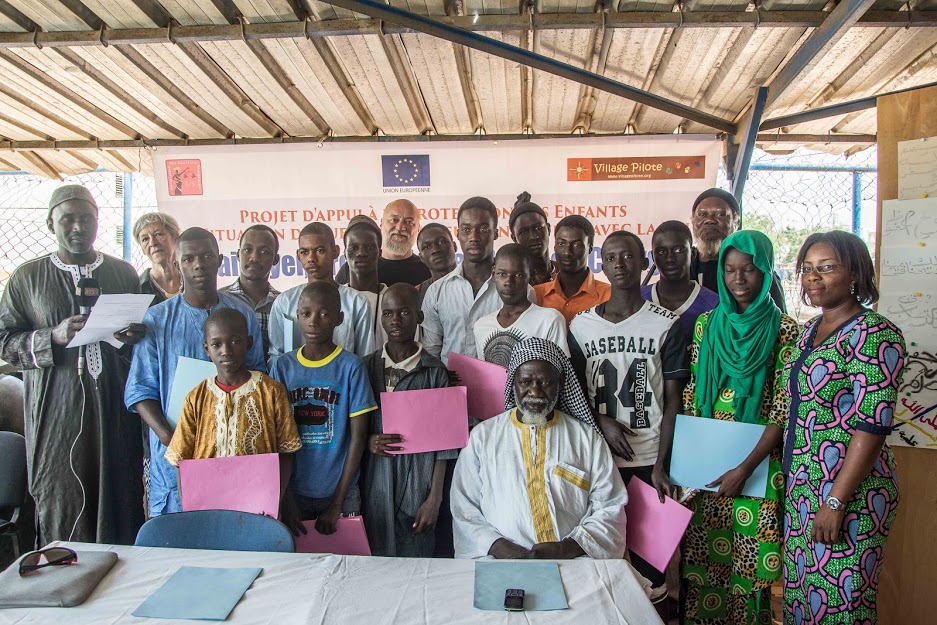
The final phase of the apprenticeship culminated in a large press conference and exhibition at Village Pilote in Pikine.  There the students presented their work and talked about their experiences.  The taalibes were extremely proud of their work and we were proud of the effort they put into being part of such an important project.

While this project required a huge effort on behalf of Yelimane and all the organizations involved, what it accomplished was unique.  For the first time Daaras are allowing contact with non-profit organizations from Senegal and Europe, which is crucial if we are to work together with the government to create better living and learning conditions for the taalibes.  Additionally, the West African Calligraphy Institute was able to focus on its core mission in an expansive way, bringing both the knowledge of calligraphy and the joy of creation to hundreds of young people around Dakar.

It is the goal of the West African Calligraphy Institute to find a permanent residence where students from all over can come to study and preserve the unique form of Arabic Calligraphy found in West Africa. And although funding for a second round of Project Xalima is currently up in the air, it is our hope others will see this great accomplishment and help us to make the dream of a permanent Calligraphy Institute a reality.

DSC_8203